TSX Venture, ASX and OTC: what European investors should know about these venues
Many interesting small caps are not listed in Frankfurt but in Toronto, Sydney or the US over-the-counter market. Which rules apply, where the differences lie, and what to watch when trading from Europe.
Carsten Schmider5 min read
In brief
TSX Venture Exchange
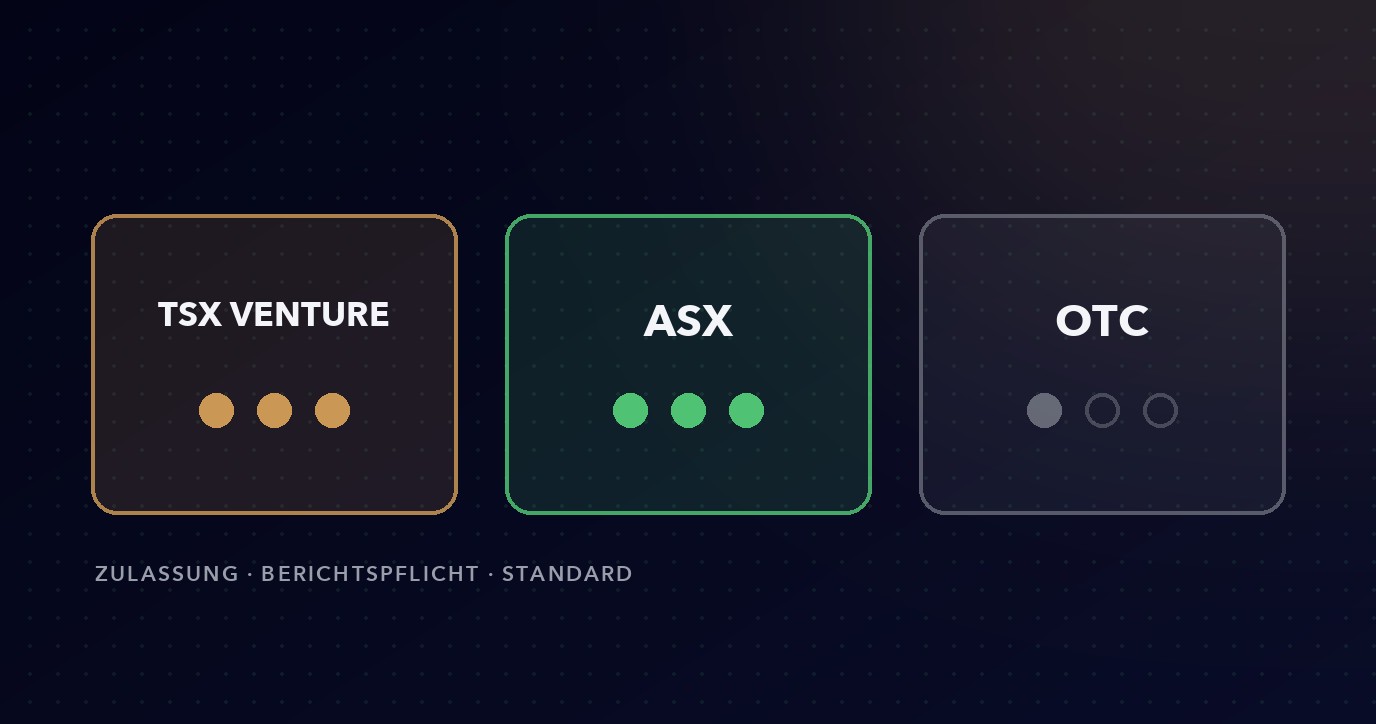
The TSX Venture is the Canadian exchange for young companies, historically the most important venue for resource explorers. It is regulated: companies must meet listing requirements and report regularly. Mining projects additionally fall under the NI 43-101 reporting standard, which prescribes how resources and reserves must be determined and published.
That standard is why Canadian explorers, for all their risk, are comparatively checkable: there is a binding format the numbers must take, and a named qualified person who stands behind them.
Australian Securities Exchange
The ASX is Australia's central venue and covers everything from large corporations to explorers. Resource projects fall under the JORC Code, the Australian counterpart to NI 43-101, with similar logic: defined categories for resources and reserves, and named competent persons.
What matters in practice for European investors is the time difference. The Australian session ends before European trading properly begins, so news often meets a market that will only price it in on the home exchange the following day.
The US over-the-counter market, in tiers
“OTC” is not an exchange but trading through dealer networks. It is organised in tiers whose requirements differ substantially — from segments with ongoing reporting duties and audited accounts to others with very low requirements, where little verifiable information exists.
A company's tier is therefore one of the first things to check. It says nothing about the quality of the business, but a great deal about how well you can assess it at all.
Secondary listings in Germany
Many of these companies can also be traded in Frankfurt, Stuttgart or Berlin. That is convenient, with two catches. First, liquidity there is usually a fraction of the home exchange, which widens spreads. Second, outside home trading hours the German price is only an estimate — it can drift well away from what actually trades when the main market next opens.
What else belongs in the calculation
Currency. Canadian and Australian companies are quoted in local currency. Your return in euros is the sum of price movement and exchange rate; the two can pull in the same direction or against each other.
Trading hours. Trading on the home venue requires a broker who offers it and a willingness to work with those hours.
Tax. Foreign dividends attract withholding tax, and the credit depends on the applicable double taxation treaty. For most explorers this is secondary for want of a dividend; for producing companies it is not.
Frequently asked questions
Is trading on the home exchange always better?
Usually yes, because that is where the liquidity is and the spread is tighter. Against that stand higher order fees and currency conversion. For small order sizes the German venue can work out cheaper overall; for larger ones, rarely.
What do NI 43-101 and JORC mean in practice?
Both are reporting standards for resource projects. They set out how resources and reserves must be classified and published, and who is professionally responsible for them. A figure without that framework is not a robust statement but a claim.
Why do German prices sometimes move without any news?
Often because trading took place on the home exchange and the German market maker adjusted, or because a single small order moved the price in a thin book. Neither says anything about the company.

Carsten Schmider
Analyst for small and micro caps in the German-speaking market. Running his own research house since 2003, focused on the OTCBB, TSX-V and ASX segments.
More about the author